
How to Automate Tests of Details in Excel
Audit Automation
Excel
A practical look at how DocMaster changes the mechanics of a test of details — from accounting records already in Excel, through document upload and matching, to a review-ready working paper.
DocMaster Team
13 July 2026 · 8 min read
Accounting records
Date · Vendor · Amount · Post_ID
Structured Excel table
Matched · Exceptions flagged
Figure 1. From supporting documents to audit-ready Excel tables.
Why tests of details remain unnecessarily manual
The accounting records for a test of details are almost always already in Excel — a sample pulled from the general ledger, with vendor, amount, date and posting reference sitting cleanly in a table. The supporting evidence is a different story. The client sends invoices, delivery documents, CMRs and contracts separately, in whatever format and file name their own systems happen to produce.
The auditor then works against two disconnected sources: a tidy accounting table on one side, and a folder of loose files on the other. Each document has to be opened, its type identified, and its data copied by hand into the working paper. Where an invoice is supported by a delivery document or a contract, the auditor also has to work out which files belong together before any comparison is possible. Differences and missing evidence are then tracked manually, often in a separate column or a running note.
None of this is analytically difficult. It is coordination work — matching disorganised files to an already-structured accounting table — and it consumes a disproportionate share of the time allocated to the test.
The traditional Excel-based process
Take a typical example: eight purchase transactions selected from the accounting records, shown below as they’d sit in the workbook.
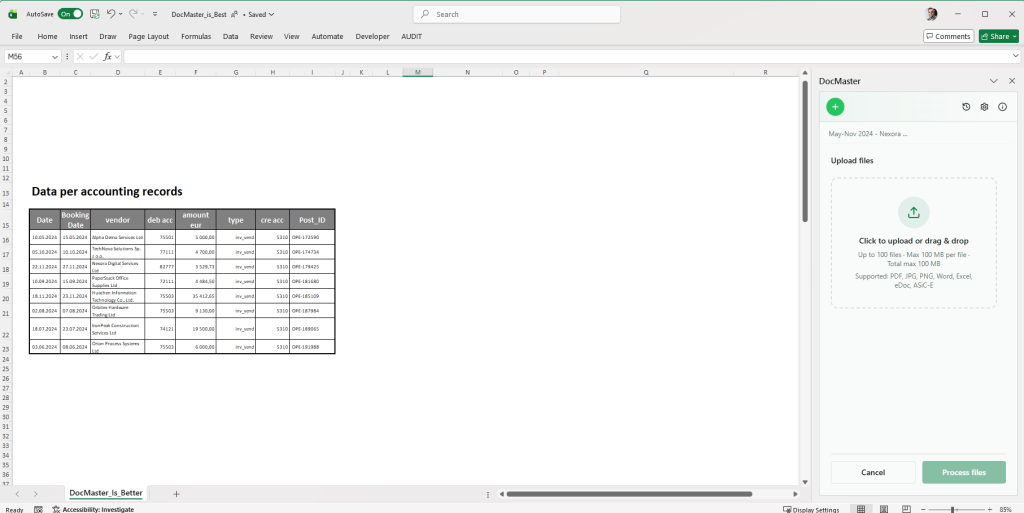
Figure 2. The audit sample remains in Excel while supporting documents are uploaded through the DocMaster side panel.
The client responds with eight invoices and two additional supporting documents — a mix of clean PDFs, a poor-quality scan, a delivery document, and one invoice issued in a different currency. Some of these documents relate to the same transaction: a delivery document may reference an invoice already provided, or a CMR may confirm shipping terms for a separate line.
Working through this manually, the auditor opens each file, decides what type of document it is, transcribes vendor, date, amount and currency, and then searches the accounting table for the matching entry. A scan taken at an angle takes longer to read accurately. A delivery document with no invoice number requires cross-checking the description and vendor to find its accounting match. By the time all ten documents are processed, most of the effort has gone into file handling rather than into evaluating the evidence itself.
The DocMaster workflow inside Excel
DocMaster follows the same sequence, but changes how the supporting-document side of the work gets done.
Step 1 — Start with accounting records. The sample already sits in the workbook: transaction date, booking date, vendor, debit account, amount, transaction type, credit account and posting ID.
Step 2 — Upload supporting documents. The auditor opens DocMaster in the Excel side panel and drags in the supporting files. They do not need to be renamed, classified or sorted first.
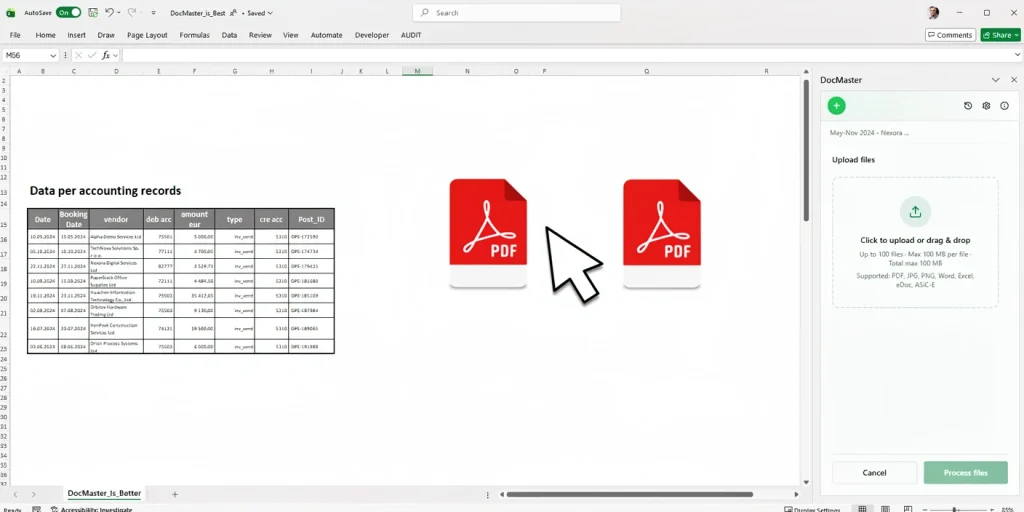
Figure 3. DocMaster identifies invoices and other supporting documents before linking them to accounting records.
Step 3 — DocMaster extracts and organises the evidence. Document type, document number, date, description, vendor or other party, amounts, currency, file name, page number and a reliability score are extracted where present in the document — not every field will exist on every file.
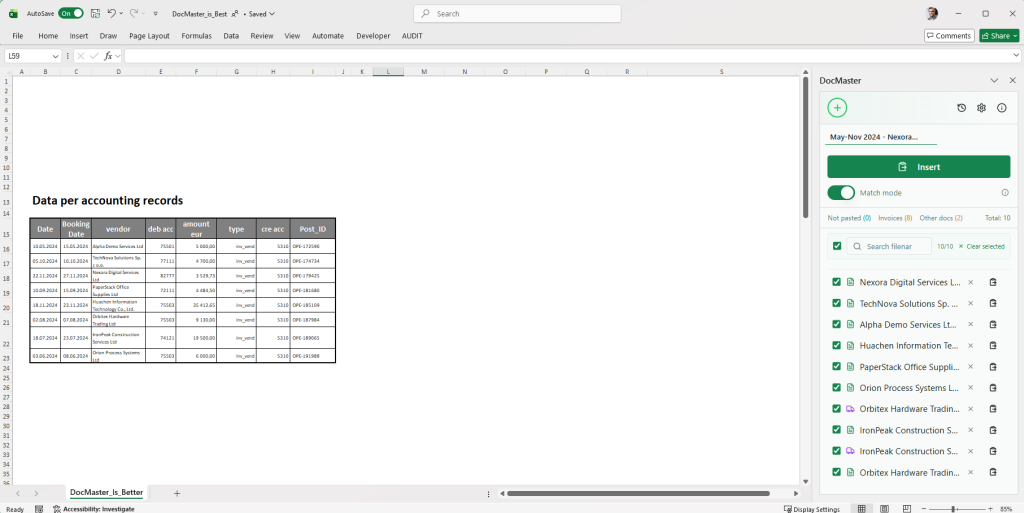
Figure 4. DocMaster converts mixed supporting documents into a structured Excel table with extracted fields and reliability information; the same panel controls header colour, font and alignment so the table matches the firm’s working-paper style.
Step 4 — Link supporting documents to accounting records. With Link mode enabled, invoices are linked to accounting entries, and where relevant to delivery documents, CMRs or contracts covering the same transaction. Several documents may belong to a single accounting entry.
Step 5 — Match and insert results into Excel. The extracted data is matched to the corresponding accounting record, and a compact, formatted supporting-document table is inserted directly beside it, so vendor, date, amount, currency, document number, file name and description sit next to the corresponding ledger line.
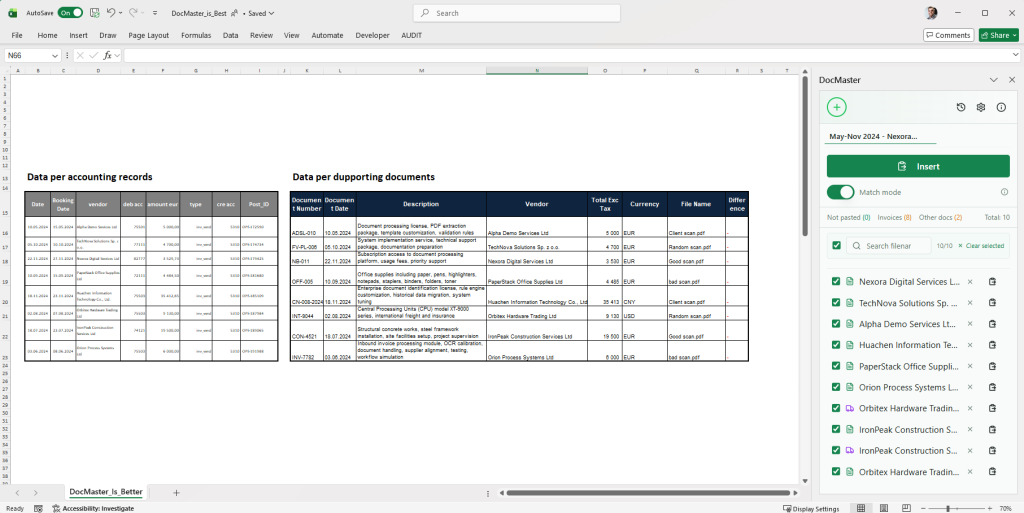
Figure 5. Extracted supporting-document data is inserted beside the accounting records for direct review.
Step 6 — Review exceptions. The auditor’s attention goes to unmatched entries, missing invoices, amount or currency differences, inconsistent dates, low-reliability extractions, additional supporting documents, and any contradictory evidence. DocMaster organises the evidence and highlights where review is needed; the audit conclusion remains the auditor’s.
What DocMaster automates, and what remains with the auditor
- Document intake and classification
- Field extraction across mixed formats
- Structured Excel output
- Linking invoices to other evidence
- Organising multiple documents per entry
- Flagging apparent differences
- Consistent working-paper formatting
- Authenticity of evidence
- Business purpose
- Authorisation
- Cut-off and classification
- Related-party indicators
- Fraud risk and unusual terms
- Sufficiency of audit evidence
Why staying inside Excel matters
DocMaster works inside the same workbook where the audit sample and working papers already live. There is no separate document-processing platform, and no export-import cycle between systems — the supporting-document table appears next to the accounting data it relates to, and can be adapted to the firm’s own working-paper format. In practice, this lets assistants and seniors carry out the operational upload-and-match work, while managers and partners review the resulting working paper directly.
Security and deployment
DocMaster is deployed centrally through the Microsoft 365 Admin Center, so firms can assign access to selected employees rather than installing it individually. Processing runs on EU-based servers, with TLS 1.3 encryption in transit; encryption at rest is on our roadmap. Documents are not used to train AI models. Documents and results are retained for the life of your account so they remain available for review, and are deleted on account closure or request. The add-in works within the active Excel environment and does not reach into unrelated files.
Practical conclusion
DocMaster does not automate the audit opinion. It automates the movement from disorganised supporting documents to a structured, review-ready Excel working paper — so that the auditor’s time is spent evaluating evidence rather than retyping it.
Frequently asked questions
No. DocMaster works inside the existing workbook and inserts results beside the accounting records already selected for testing — it does not impose a separate sampling or documentation method.
PDFs, images, ZIP files, JPEG, PNG, Word, Excel, eDoc and ASiC-E files, in mixed formats and without prior sorting.
Yes. Link mode can connect invoices with accounting records, delivery documents, CMRs, contracts and other supporting evidence, including cases where several documents relate to one transaction.
Documents are processed on EU-based servers and are not used to train AI models. Results are retained for the life of your account so you can review them later, and are deleted on account closure or request.
No. DocMaster organises and flags exceptions in the evidence; assessing authenticity, business purpose, authorisation and sufficiency of audit evidence remains the auditor’s responsibility.
See how DocMaster turns mixed supporting documents into matched, structured audit evidence directly in Excel.